
The Hidden Code. They Couldn't Write It Down, So They Painted It
Historical detective: a silent record left by women who had no other voice.

Stand on the hill of Castellengo Castle and look down. The plain spreads out endlessly before you, flat and quiet.
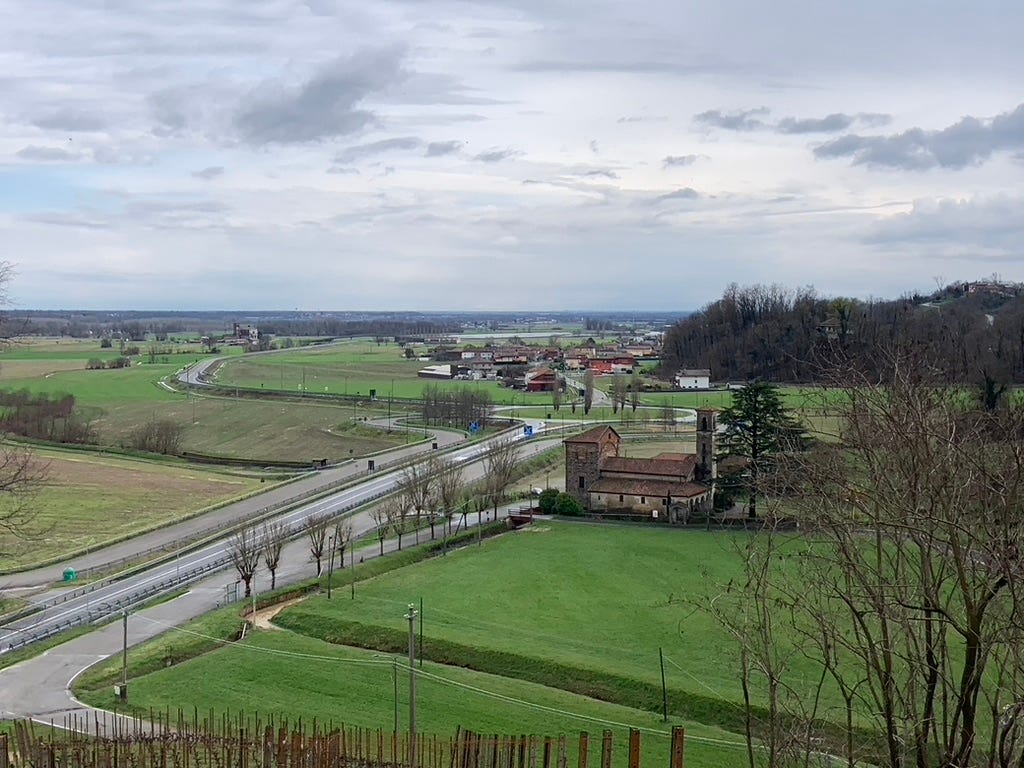
But look closer, just below the castle hill: there is a church. The Church of Saints Peter and Paul sits there as it has for centuries, and even from a distance, something about it feels odd. Its back faces the road. It turns away from you, as if keeping a secret.
That oddness is, in fact, a very precise statement.
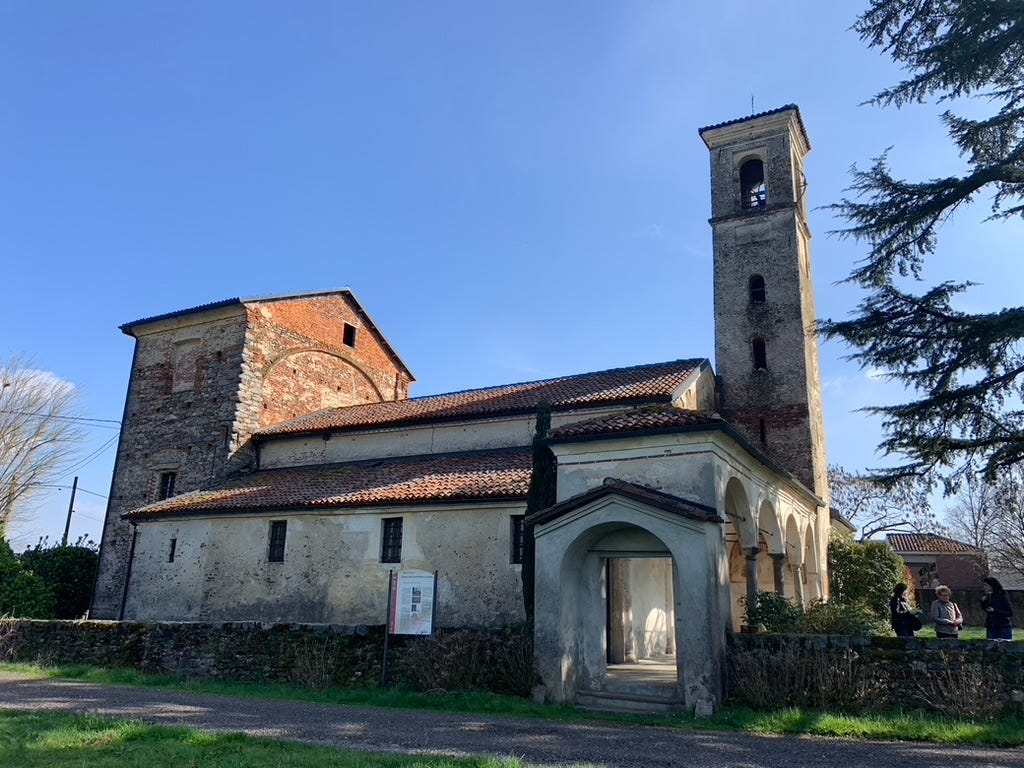
Churches were built for people who could not read. Every stone, every orientation, every image was a lesson written in a language older than words. This one follows the ancient rule: the altar faces east, toward the rising sun at dawn. Because Christ was imagined as the sun, the light that conquers darkness. So the faithful entered from the west, from shadow, from what the builders called death, and walked forward toward the light. The door was never meant to face the road. It was meant to face the dark.
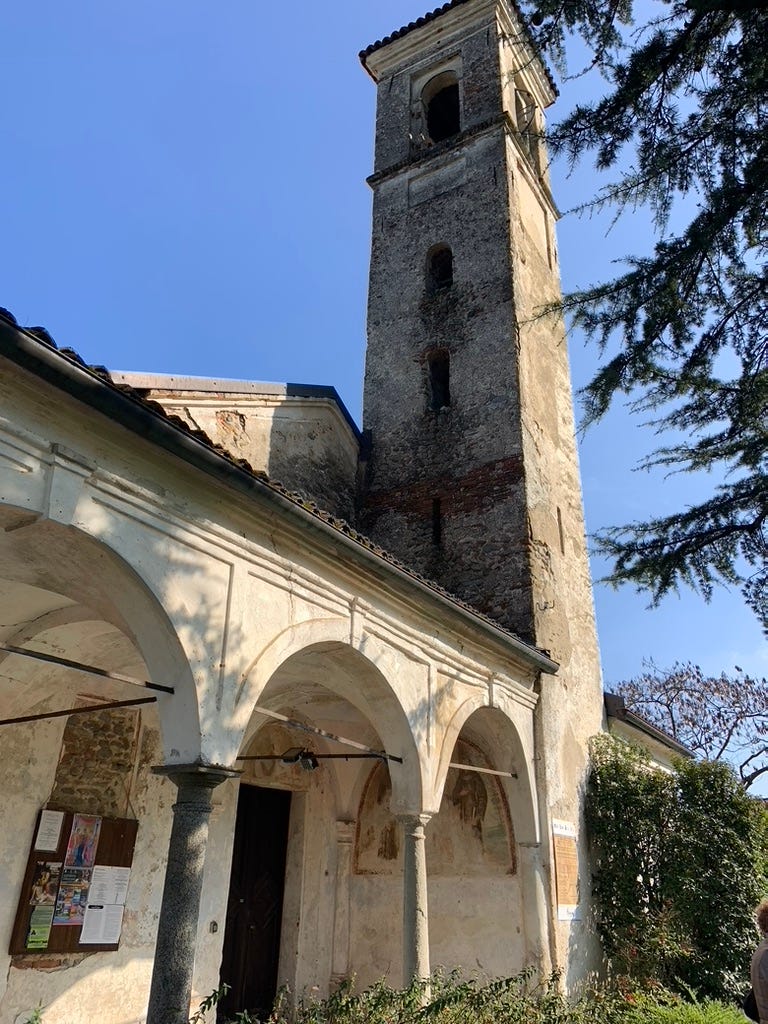
Go inside. Your eyes adjust. The first thing you notice is that the walls are alive.
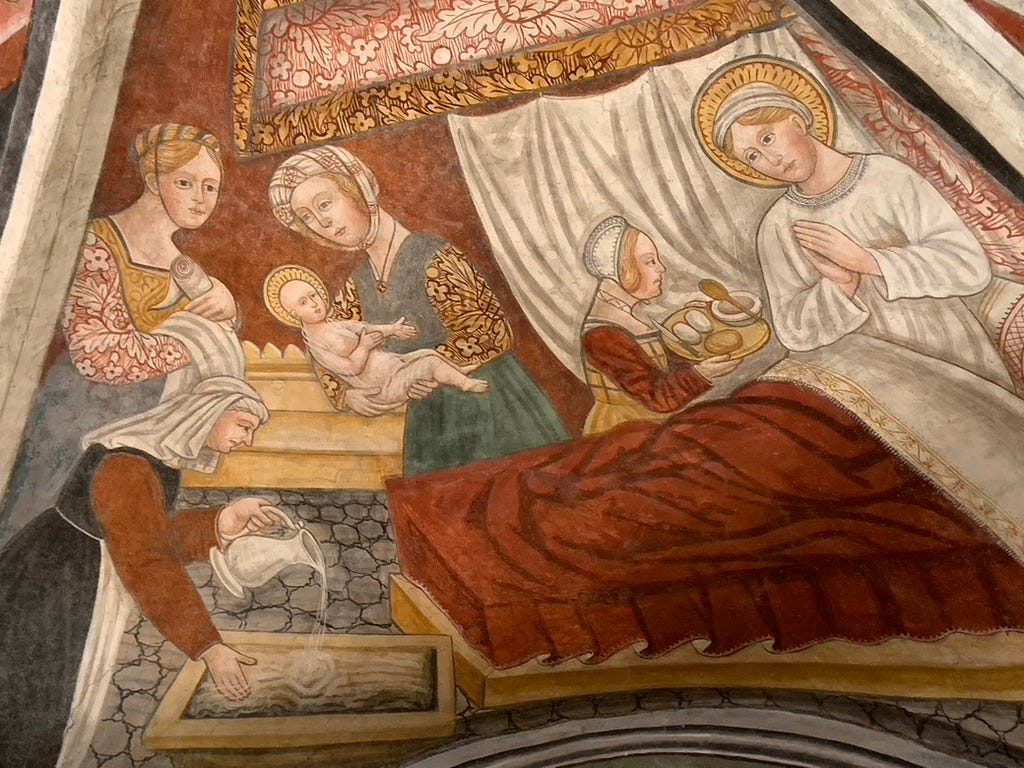
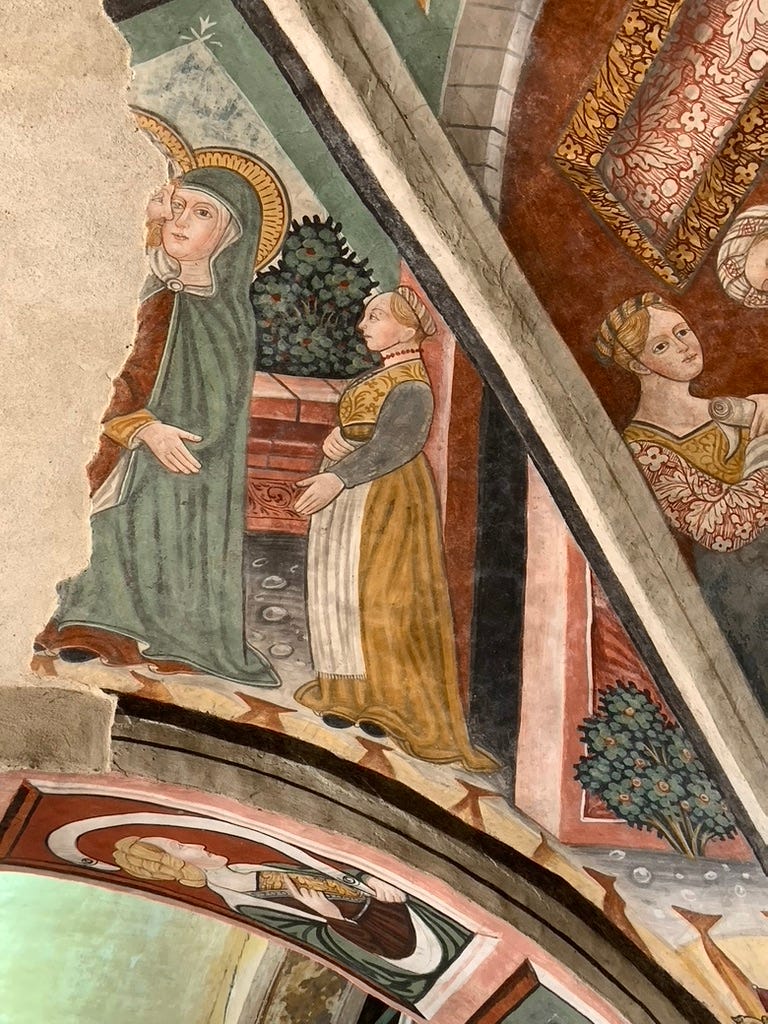
The frescoes date from 1515 — there is a date, painted right into the plaster, as if someone wanted to make sure we remembered when they were there. A painter’s workshop, skilled and unhurried, covered these walls with the world they knew: the clothes people wore, the way women tied their headdresses, the cut of men’s trousers. It is a photograph made with pigment and patience. A whole society preserved in lime.
But there is one fresco that stops you before any other.
It is large — unusually large for a side nave. And unlike the others, it sits where you cannot miss it. The moment you step through the door, before your eyes have finished adjusting to the light, it is already there in front of you. A woman with a serene expression, something almost like a smile — the kind of smile you see on the Mona Lisa, that expression of inner composure that unnerves rather than reassures. She is tied to a cross. Her body is bare. Two men lean toward her with knives, and her flesh already shows the cuts. They are cutting off her breasts.
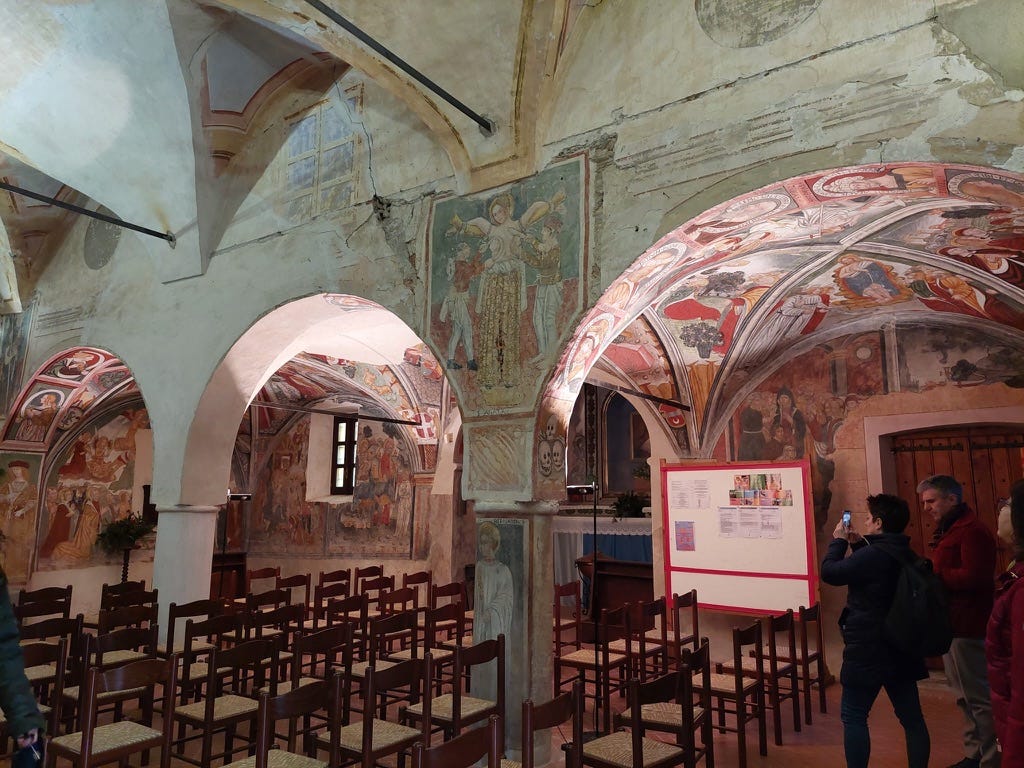
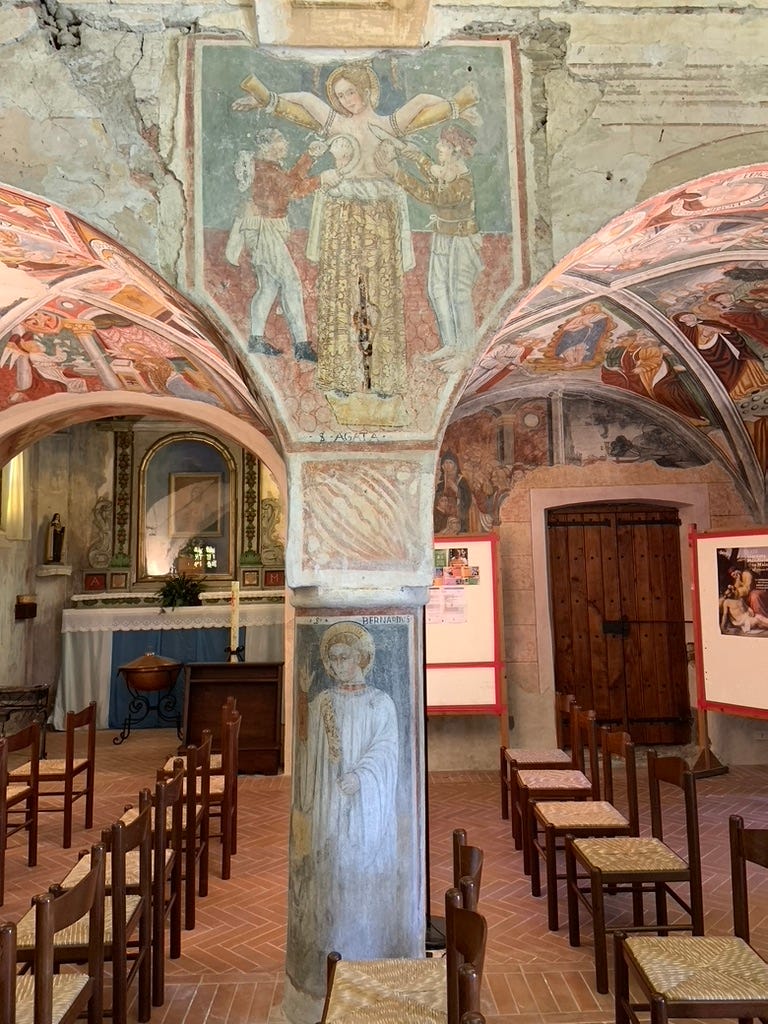
This is Sant’Agata — Saint Agatha — and to modern eyes the image is violent and stark. The obvious question, standing there in the quiet of this small Piedmontese church, is: why? Nothing in a church was placed by accident. Why this saint? Why this size? Why is the first thing you see?
Here is where the walls begin to speak.

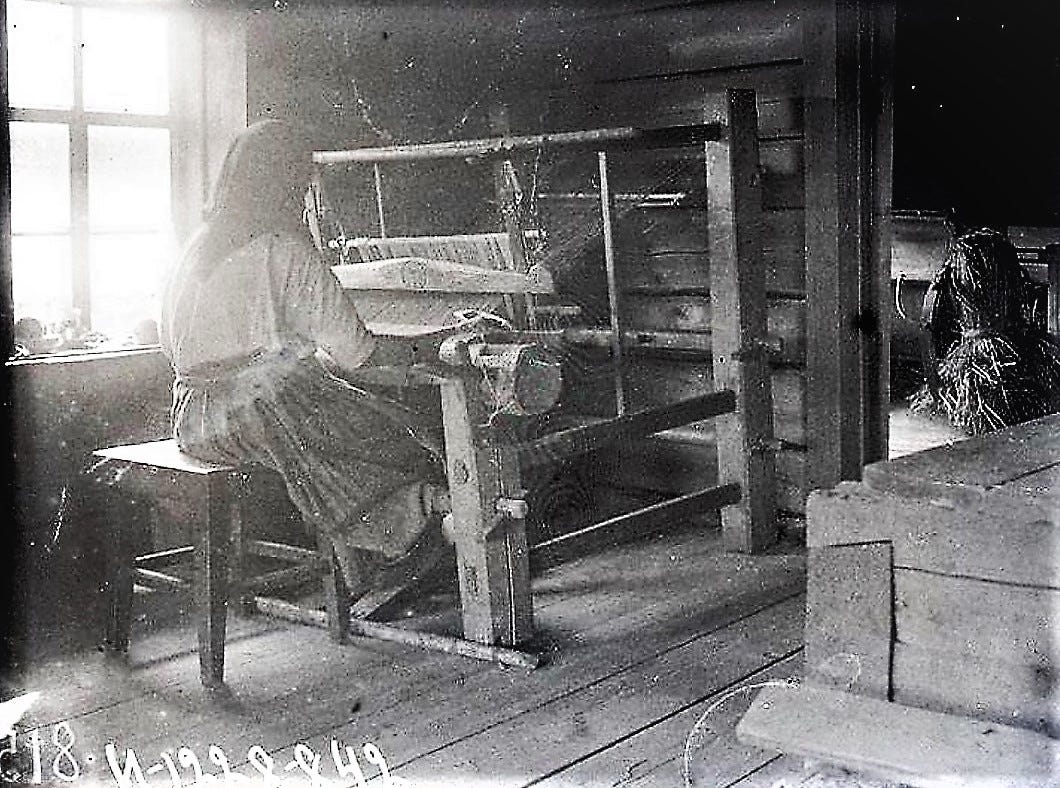
The area around Castellengo, in the early sixteenth century, was far more populated than it is today. The road to Biella passed through here, and Biella was already the heart of what would become one of Italy’s great textile regions. Wool and fabric moved through these valleys. And where fabric moved, women worked. They worked at looms — hours, days, perhaps nights — pulling the batten back, pressing the weft down hard into the cloth, again and again, with the full weight of the motion falling across the chest. Depending on the height of the woman and the height of the loom, the blow landed in the same place every time.
Knots. Inflammation. What we would today call occupational disease. What we would today call cancer.
Historical background
Is there a connection between S. Agata and S. BERNARDUS below?
The connection between the two saints is real, and it is actually quite layered. The most direct link is through wool and textiles.
San Bernardo di Chiaravalle (1090–1153) was the founding father of the Cistercian Order, and the Cistercian abbeys across Europe were instrumental in the success of the wool trade — known for their “enterprise and entrepreneurial spirit,” they were catalysts for the development of a market economy through much of the 12th century.
The Cistercians owned vast farmlands, bred sheep, and traded raw wool on a continental scale. In northern Italy — precisely the area of Biella and Piedmont — their influence in establishing the textile economy was significant.
By the middle of the 12th century, the Cistercians had reached the cutting edge of hydro-power and agricultural technology. A typical monastery straddled an artificial stream brought in through a canal — running through the workshops and living quarters, providing power for milling, wood cutting, forging, and olive crushing, as well as running water for cooking, washing, and sewage disposal. These monasteries were, in reality, the best-organized factories the world had ever seen.
And wool was their biggest business. The Cistercian houses played a very active part in the wool trade — the abbeys of Yorkshire alone boasted enormous flocks: Rievaulx had 14,000 sheep; Fountains, the largest, had 18,000.
In Wales, the story was even more dramatic: the monks were granted thousands of hectares of grazing land, where they essentially pioneered the Welsh woollen industry — there is very little evidence that sheep were important to the Welsh economy before the Cistercians arrived at all.
S. Bernardus, the spiritual father of the whole textile economy, painted just below the saint who protected the women his industry was quietly destroying. Intentional or not, it is quite a portrait of the medieval world in two frescoes.
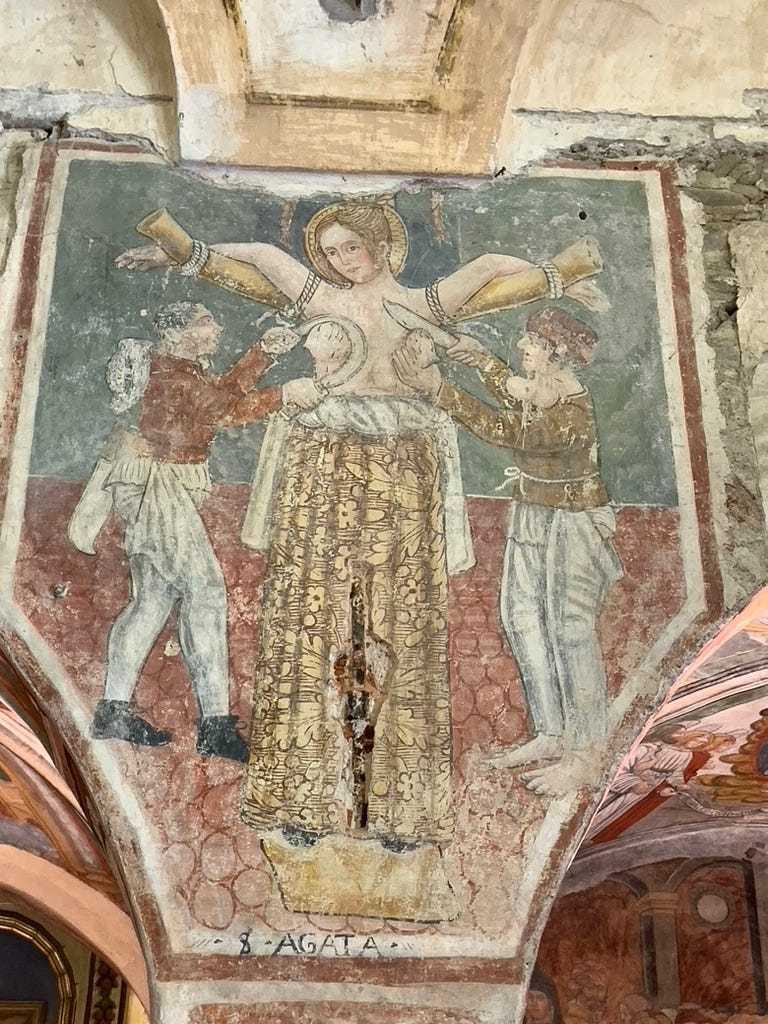
There was no word for it then. There was no compensation, no medical literature, no entry in any chronicle. The women who suffered from it had no language that the powerful world would recognize. What they had was the church. And in the church, they had her: a saint who knew exactly what it meant to have that part of your body become the site of violence and pain. A woman who had endured it, who had survived it — legend holds she was miraculously healed in her prison cell — and who could therefore understand suffering no man would ever think to write about.
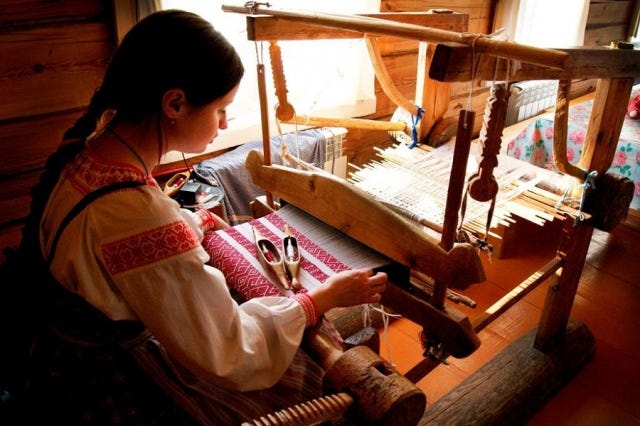
It is worth pausing on what this connection meant. Sant’Agata was, by long tradition, the patron of weavers — linked to the loom through a legend in which she outwitted a persistent suitor by weaving during the day and unraveling her work at night, like Penelope, until he gave up. The women of this valley would have known that. When they came to this church and looked at that fresco, they were looking at someone who was their patron of their work, witness to their specific suffering, a woman who could understand what no physician named and no husband saw.
The size of the fresco tells you how serious the problem was. The position tells you it was not tucked away, not private, not shameful. It was the first thing you saw when you entered. A declaration, painted in the best available hand, in the year 1515, in a small church on a road in Piedmont.
No writer mentioned it. No chronicle recorded it. If they had, we would search the archives and find a footnote, a statistic, a case study. Instead, we have something rarer: the record that the women themselves left, in the only medium they controlled, in the only institution that gave them a formal voice. They commissioned it, or they asked for it, or they gave what they had so that someone would paint it where it could not be missed.
It was their way of saying: we are here. This is happening to us. She knows.
Slow travel is often described as moving more carefully through space. But sometimes it means standing still in a half-dark nave and letting a five-hundred-year-old fresco explain something that history forgot to write down. The women who stood where you are standing had no other way to leave this message. They left it anyway.

If you enjoy my free stories, you could also support my work with a one-time donation to my PayPal account.

ARE YOU INTERESTED IN OTHER STORIES?
You can find MY EBOOKS HERE

Interesting and moving story. Looking at the fresco, I wouldn't have guessed, though, after your explanation, it makes sense. Thanks for unearthing this side of life in old times.